
Fibra™ Updates: Cutting-Edge Technology Meets Women’s Health
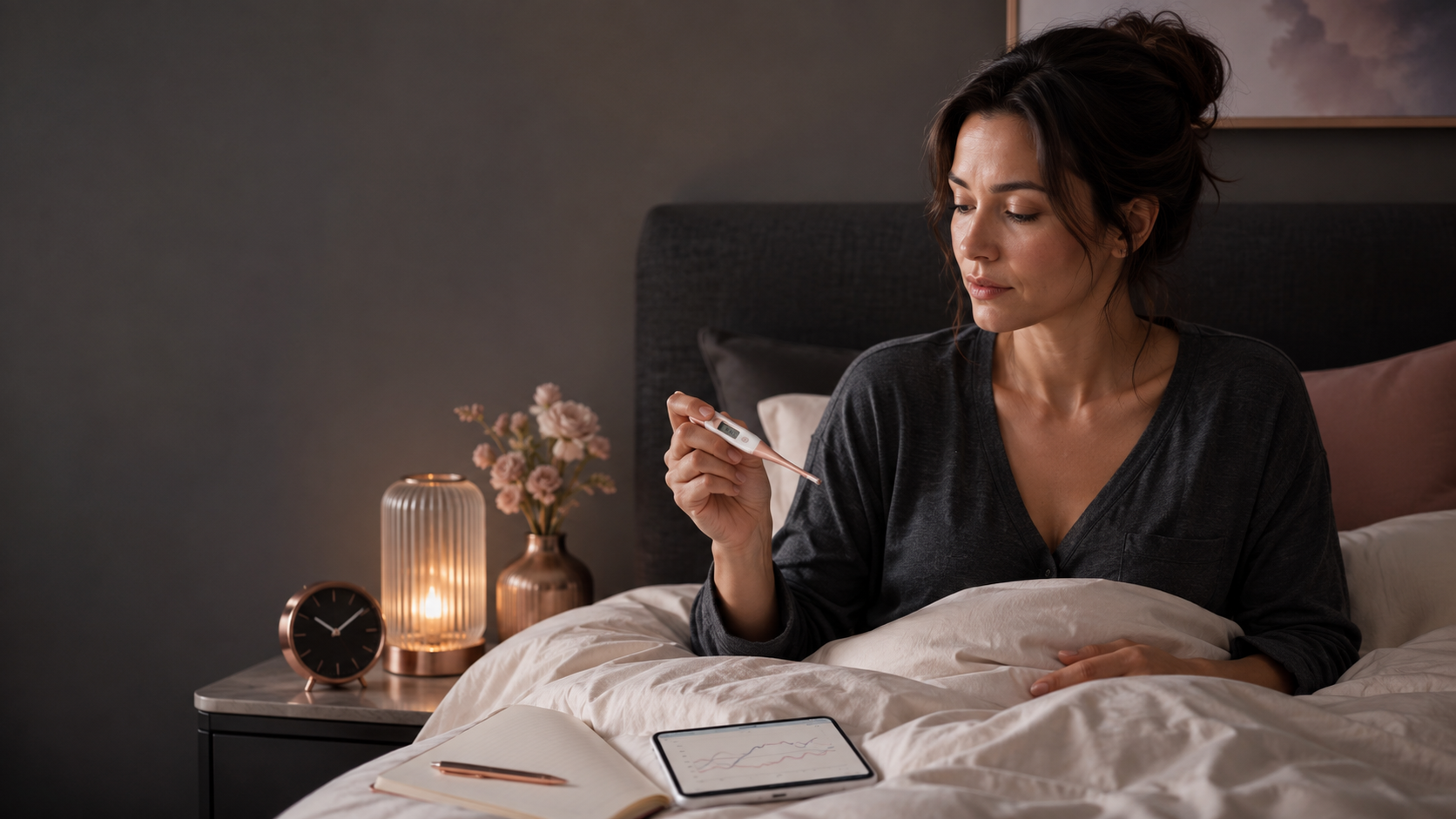
You wake at 3:20 a.m., fall asleep again, and take your temperature at 6:30. Should you keep the reading? You worked a night shift, slept for four hours in the afternoon, or got up twice with a baby. Does the chart still count?
BBT tracking with disrupted sleep can become frustrating because basal body temperature is intended to reflect the body at rest under reasonably consistent conditions. Poor or irregular sleep does not automatically make an entire chart useless, but it can add variability and make individual readings harder to interpret.
Quick answer: Take your BBT as consistently as your circumstances allow, record the measurement conditions, and look for a sustained multi-day shift rather than judging one value. A disturbed reading may still be useful when clearly labelled. Oral BBT provides retrospective context consistent with ovulation; it does not predict ovulation with certainty or diagnose a fertility problem.[1][2]
Basal body temperature is the body’s temperature under resting conditions. For home fertility tracking, it is commonly measured immediately after waking and before getting out of bed, eating, drinking, talking, or beginning normal activity.
After ovulation, progesterone has a thermogenic effect and resting temperature typically rises. Reviews describe luteal-phase resting core temperature as approximately 0.3°C to 0.7°C higher than during the follicular phase, although the observed change and clarity of a home chart vary between individuals.[2]
This means BBT is mainly retrospective. A sustained shift can provide evidence consistent with ovulation having already occurred. It cannot identify the fertile window early enough on its own, and one high reading does not prove ovulation.
There is no single research-backed number of uninterrupted sleep hours that makes every BBT reading valid or invalid. Many fertility-awareness instructions recommend taking BBT after a consistent block of sleep, but the exact rule depends on the method and device being used.
The practical priorities are:
Do not present “three hours of sleep” as a universal biological cutoff unless that is the explicit rule of the method you follow.
It may still contribute useful information, but interrupted sleep can make the reading less comparable with your usual measurements.
Consider recording:
If the reading looks unusual, label it as disturbed. Deleting every inconvenient value can make a chart look cleaner while hiding the real uncertainty.
The important feature is usually not whether one morning was “perfect.” It is whether a sustained pattern emerges across several days.
Follow the rules of your chosen method rather than switching strategies from day to day. If you briefly wake at 3 a.m. and normally rise at 7 a.m., many users measure at their usual waking time. If you are awake for a long period or get out of bed, the later reading may be more disturbed.
For recurring night waking, it may help to record both the situation and the chosen measurement rule consistently. Avoid taking several readings and selecting whichever number best matches the curve you hoped to see.
If BBT is being used as part of a formal fertility-awareness method, consult a trained instructor for that method’s specific disturbed-temperature rules.
Shift work can make clock-time consistency difficult because sleep happens at different parts of the day and circadian rhythms influence body temperature.
A practical approach is to anchor measurement to your main sleep episode rather than pretending that one conventional morning time fits every schedule. Measure immediately after waking from that sleep, before normal activity, and record the shift and sleep interval.
Even with careful tracking, rapidly rotating shifts may produce a noisier chart. That does not mean you failed. It means the measurement conditions changed.
If you need high-confidence ovulation confirmation for clinical care, discuss more appropriate testing with a healthcare professional rather than relying on a difficult-to-interpret chart alone.
There is no simple rule that poor sleep always pushes a home BBT reading in one direction. Sleep timing, duration, wakefulness, circadian phase, measurement time, activity, illness, and environment can interact.
That is why correcting a reading by adding or subtracting a fixed amount for each hour is not recommended unless a validated method or device specifically instructs you to do so. A mathematical adjustment can create false precision.
Record the actual measurement and its context instead.
Common sources of variation include:
Not every factor affects every person equally. The purpose of annotation is not to explain away all variation. It is to preserve context when reviewing the overall pattern.
A post-ovulatory temperature pattern is generally a sustained rise, not a single spike. The exact charting rule depends on the fertility-awareness method, so avoid mixing rules from different systems.
A rise may be harder to interpret when:
BBT can be useful, but a review of ovulation-detection methods notes that its performance is limited when used as a stand-alone method.[1] If confirming ovulation is medically important, a clinician may recommend appropriately timed progesterone testing, ultrasound, or another assessment.[3]
No. Oral BBT and wearable skin temperature are different measurements.
Oral BBT is a spot measurement taken after waking. Wearable skin temperature may be collected repeatedly or continuously at a specific body location. Skin temperature is influenced by measurement site, blood flow, environment, sensor contact, and device processing.
Research has found that nocturnal wearable temperature patterns can capture menstrual-cycle changes, but performance depends on the sensor, location, study population, and algorithm.[4][5] Findings about one wrist, finger, or axillary device should not automatically be transferred to another product.
The accurate language is that skin-temperature trends may provide cycle-related context—not that skin temperature and BBT are interchangeable.
Continuous or repeated measurements can reduce the burden of remembering one perfect morning reading and provide a longer time series. They may also allow a system to examine patterns rather than a single snapshot.
Potential advantages include:
However, continuous collection is not automatically more clinically accurate than validated BBT practice or laboratory testing. Sensor location, comfort, contact, calibration, data quality, and algorithms all matter.
Instead of relying primarily on indirect signals measured at the wrist, Fibra’s patented smart underwear is designed to continuously monitor reproductive-health biomarkers and physiological signals closer to where relevant biological changes occur.
By observing personal patterns through vaginal discharge volume and pH, skin-temperature trends, heart rate, and heart-rate variability, Fibra is designed to provide personalized insights into fertility, cycle health, hormonal changes, and broader reproductive wellness.
Building Fibra was not about creating another wearable. It was about rethinking where wearable technology belongs in the first place. That meant rethinking smart textiles, wearable electronics, signal processing, comfort, durability, and manufacturing.
For cycle tracking, Fibra is designed to collect several physiological trends within one wearable system. This may help users build a more continuous personal record with less dependence on one manual temperature reading taken at precisely the same moment every day.
This should not be interpreted as a promise that disrupted sleep no longer matters or that continuous readings are automatically more accurate. Fibra does not directly measure reproductive hormones, diagnose fertility conditions, definitively confirm ovulation, guarantee fertile-window accuracy, provide contraception, or replace clinical testing. Its skin-temperature trends are not identical to oral BBT.
If your temperature routine is costing you sleep, explore a less hands-on way to understand your personal patterns. See how Fibra works and learn how cycle tracking fits within a broader reproductive-wellness platform.
When to seek medical advice
Speak with a qualified healthcare professional if your periods are persistently absent or highly irregular, you are concerned that you may not be ovulating, or you have unexpectedly heavy bleeding, severe pelvic pain, pregnancy concerns, or other worrying symptoms. If you are trying to conceive, ask when an evaluation is appropriate for your age and health history. A temperature chart cannot diagnose the cause of an unusual cycle.
Poor or interrupted sleep can add variability, but one disturbed night does not automatically invalidate the entire chart. Record the reading and label the circumstances. Focus on a sustained multi-day shift rather than one isolated value.
There is no universal cutoff that applies to every method or person. Follow your chosen method’s instructions, aim for consistent resting conditions, and record when sleep duration or timing differs substantially from normal.
Not automatically. Keeping and labelling a disturbed reading preserves useful context. Your method may have specific rules for excluding a value from interpretation, but deleting values only because they do not fit the expected curve can be misleading.
Yes, but variable sleep timing may create a noisier chart. Measure immediately after your main sleep episode, record the schedule, and use a consistent method. Seek clinical guidance if clear ovulation confirmation is important.
No. A post-ovulatory pattern is generally sustained across multiple readings. A single spike can reflect illness, alcohol, measurement timing, sleep disruption, or ordinary variation.
No. They use different measurement locations and collection methods. Wearable temperature trends may provide useful longitudinal context, but they should not be described as identical to oral basal body temperature.
BBT tracking often becomes stressful when every unusual number is treated as failure. Biology and daily life are both variable. A useful chart preserves that reality, documents disturbances, and looks for patterns that persist beyond one morning.
If your routine is consistently incompatible with manual BBT, the answer may not be trying harder to produce a perfect chart. It may be choosing a lower-friction tracking approach and knowing when professional testing is needed.
Explore how Fibra is designed to bring several physiological trends into one personal tracking experience and view current pre-order availability on Fibra’s public website.
Educational disclaimer: This article is provided for general educational and informational purposes only. It is not medical advice, diagnosis, or treatment and should not replace consultation with a qualified healthcare professional. Fibra does not diagnose medical conditions, directly measure reproductive hormones, definitively confirm ovulation, or replace clinical testing. Do not use Fibra, BBT, or a general period-prediction app as a standalone method of contraception.